What Is Answer Engine Optimization (AEO)? How to Get Found by ChatGPT and Google AI
By the Jutt Agency team
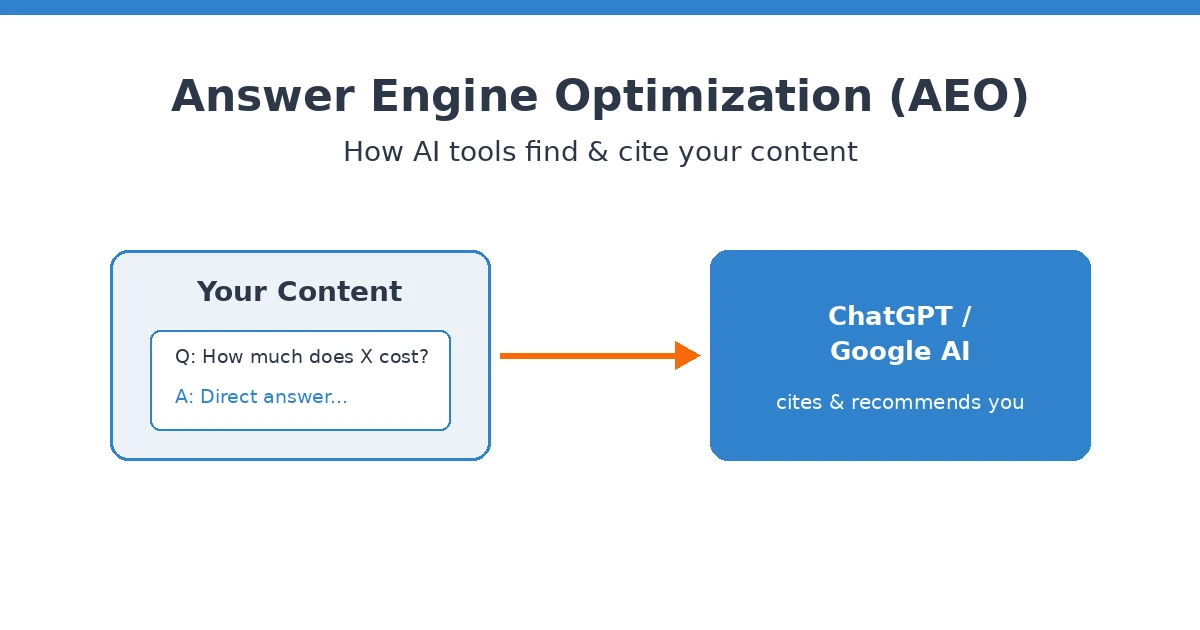
Answer Engine Optimization (AEO) is the practice of structuring your website’s content so AI tools like ChatGPT, Google AI Overviews, and Perplexity can find, understand, and cite it directly when someone asks a related question — it’s the newest layer businesses need alongside traditional SEO. More searches are starting to get answered directly by AI, without the searcher ever clicking through to a website, which is changing what “ranking” actually means.
How is AEO different from traditional SEO?
Traditional SEO optimizes for a person clicking a blue link in a list of search results. AEO optimizes for an AI system pulling a specific answer or passage from your page and presenting it directly to the user — sometimes with a citation link back to your site, sometimes without one at all. The goal shifts from “get clicked” to “get cited and trusted as the source.”
What actually helps a page get cited by AI tools?
- Direct, clear answers placed near the top of each section. AI tools pull specific passages, not entire pages — burying your best answer in the middle of a long paragraph hurts your chances of being the one that gets extracted.
- Lists, tables, and step-by-step formatting. Structured content is measurably easier for AI systems to extract and cite than long, unbroken paragraphs of prose.
- FAQ sections with direct question-and-answer formatting. Questions paired with concise, direct answers are among the most frequently cited content structures across AI platforms.
- Specific facts, figures, and named details. Concrete, specific claims are more citable than vague general statements.
- Regularly updated content. AI tools favor freshness. Pages that sit untouched for a long stretch tend to lose citations to more recently updated competitors covering the same topic.
Does a business need to choose between SEO and AEO?
No — they reinforce each other. A page that’s genuinely well-structured, clear, and directly useful tends to perform well in both traditional search rankings and AI answer citations, because both ultimately reward content that answers a real question clearly and completely. The businesses treating AEO as a “replace SEO” strategy are misreading it; it’s an addition, not a substitute.
Why does this matter specifically for local service businesses?
As more people start asking AI tools questions like “who’s a good plumber near me” or “how much does a kitchen remodel typically cost,” businesses whose websites and content are structured for AEO have a real chance of being the answer that gets surfaced or recommended — sometimes before the person ever opens a traditional search engine. A large share of what AI tools cite when answering these questions doesn’t even come from the business’s own website; it comes from third-party mentions — reviews, directories, local news, and community sites — which is exactly why review generation and community visibility directly feed into AEO performance too.
What does this look like in practice for a business’s own content?
Every service page, blog post, and FAQ section is an opportunity. A service page that just describes what you do in flowing paragraphs is far less useful to an AI tool than the same page with a clear “How much does [service] cost?” heading followed by a direct, specific answer. The content doesn’t need to be longer — it needs to be structured so the answer is unmistakable.
FAQ
Do I need special schema markup or code to rank in AI search?
Not necessarily. Recent guidance from major search platforms indicates structured data like JSON-LD isn’t required for AI Overviews or AI Mode — clear, well-organized content matters more than technical markup for actually getting cited.
How is AEO performance measured, since there’s no traditional ranking position to track?
One common approach is tracking “share of voice” — running a consistent set of relevant questions through tools like ChatGPT, Perplexity, and Google AI Mode on a regular basis, and checking how often your business gets mentioned compared to named competitors.
Is AEO only relevant for big national brands, or does it matter for small local businesses too?
It matters for local businesses specifically. AI tools are increasingly used for “near me” and recommendation-style questions, which is exactly the kind of search local service businesses have always depended on — the channel is shifting, but the underlying customer behavior isn’t new.
How long does it take to start seeing results from AEO work?
There’s no fixed timeline, since AI citation behavior is still evolving rapidly across platforms. What’s consistent is that content already structured well for AEO tends to get picked up faster than content that has to be reworked from scratch.