
Why Online Reviews Make or Break Local Service Businesses
By the Jutt Agency team
Most people read online reviews before ever calling a local service business, which means your review profile is often doing more to win or lose the job than your website is. Here’s what actually matters about reviews, and how to build a system that gets you more of them consistently.
Why do reviews matter more for service businesses than for other kinds of businesses?
Home services, medical, legal, and similar businesses ask a customer to let a stranger into their home, or to trust someone with something important — their health, their money, their property. Reviews are how a potential customer decides you’re safe to trust before they’ve ever spoken to you directly. For a retail product, a bad review might cost a sale. For a service business, a weak review profile can mean the phone simply never rings.
What matters more: review quantity or review recency?
Recency matters just as much as total count, and often more. A business with 40 reviews, several from the last month, reads as more currently active and trustworthy than a business with 200 reviews that stopped coming in eighteen months ago. Search platforms also weight recent review activity into local ranking, so a stalled review count doesn’t just look worse to customers — it can quietly cost you visibility too.
How should a business actually build a review-generation system?
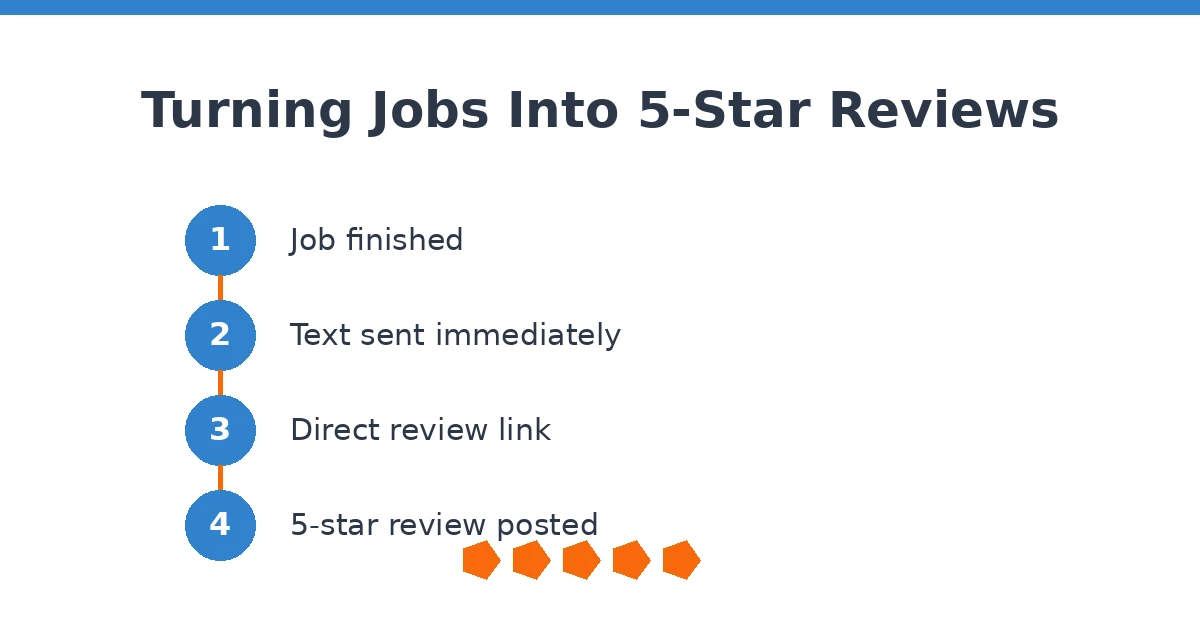
- Ask immediately after the job is done, while the experience is still fresh — not days or weeks later when the details have faded and the urgency to respond is gone.
- Make it a two-second action. A direct review link sent by text converts far better than asking someone to search for your business and find the review button themselves.
- Ask consistently, every job, not just when things went unusually well. A review-request step that’s part of the standard closing routine outperforms an ad hoc approach.
- Personalize the request. A quick text from the technician who actually did the work converts noticeably better than a generic automated email from “the team.”
- Track your ask-to-review ratio. If you’re asking every customer but only a fraction leave a review, the friction is in your process, not your customers’ willingness.
How should a business handle a negative review?
Respond promptly, professionally, and without getting defensive. A calm, specific response — acknowledging the issue and explaining what was done about it — often reassures future customers more than the negative review itself damages you. Prospective customers reading reviews aren’t just judging the complaint; they’re judging how the business handled it.
What a business should never do: ask employees, friends, or family to leave reviews for a business they didn’t actually use. Fake or incentivized reviews violate every major platform’s policies, and getting caught can mean review removal or an account-level penalty that erases legitimate reviews along with the fake ones.
How reviews connect to everything else in local marketing
Reviews aren’t a standalone task — they reinforce Google Business Profile ranking, they build the trust that makes rank-and-rent or paid lead generation convert better, and they’re increasingly a signal AI tools use when answering “who’s a good [service] near me” style questions. A weak review profile quietly undercuts the return on every other marketing dollar a business spends.
FAQ
How many reviews does a small business realistically need to compete?
There’s no fixed magic number — what matters more is consistency. Businesses that add several new reviews per month tend to outperform competitors who have a higher total review count but little to no recent activity.
Should a business respond to every single review, good and bad?
Yes. Responding to positive reviews shows appreciation and ongoing activity; responding to negative reviews shows accountability. Both influence how new customers judge you before they’ve even called.
What’s the fastest way to increase review volume without spending money?
Fixing the ask process, not spending on incentives. Most businesses lose reviews to friction — asking too late, asking through an inconvenient channel, or not asking at all — rather than to unwillingness. Tightening the timing and simplifying the link is usually the highest-leverage, zero-cost fix.
